In the last article, we learnt about two of the most basic but highly effective formulas used in the world of copywriting: PAS and AIDA.
While these help immensely in persuading a reader, we still face one major problem.
Any guesses?
It’s making sure that the reader reaches the point in the copy where they can be persuaded.
The 80/20 Rule of Copywriting
What do you think is the most significant part of a well-written copy?
It isn’t the text that you spend hours writing and polishing again and again while striving for perfection.
It’s the title.
To quote the words of advertising legend David Ogilvy, “On the average, five times as many people read the headline as read the body copy. When you have written your headline, you have spent eighty cents out of your dollar.”
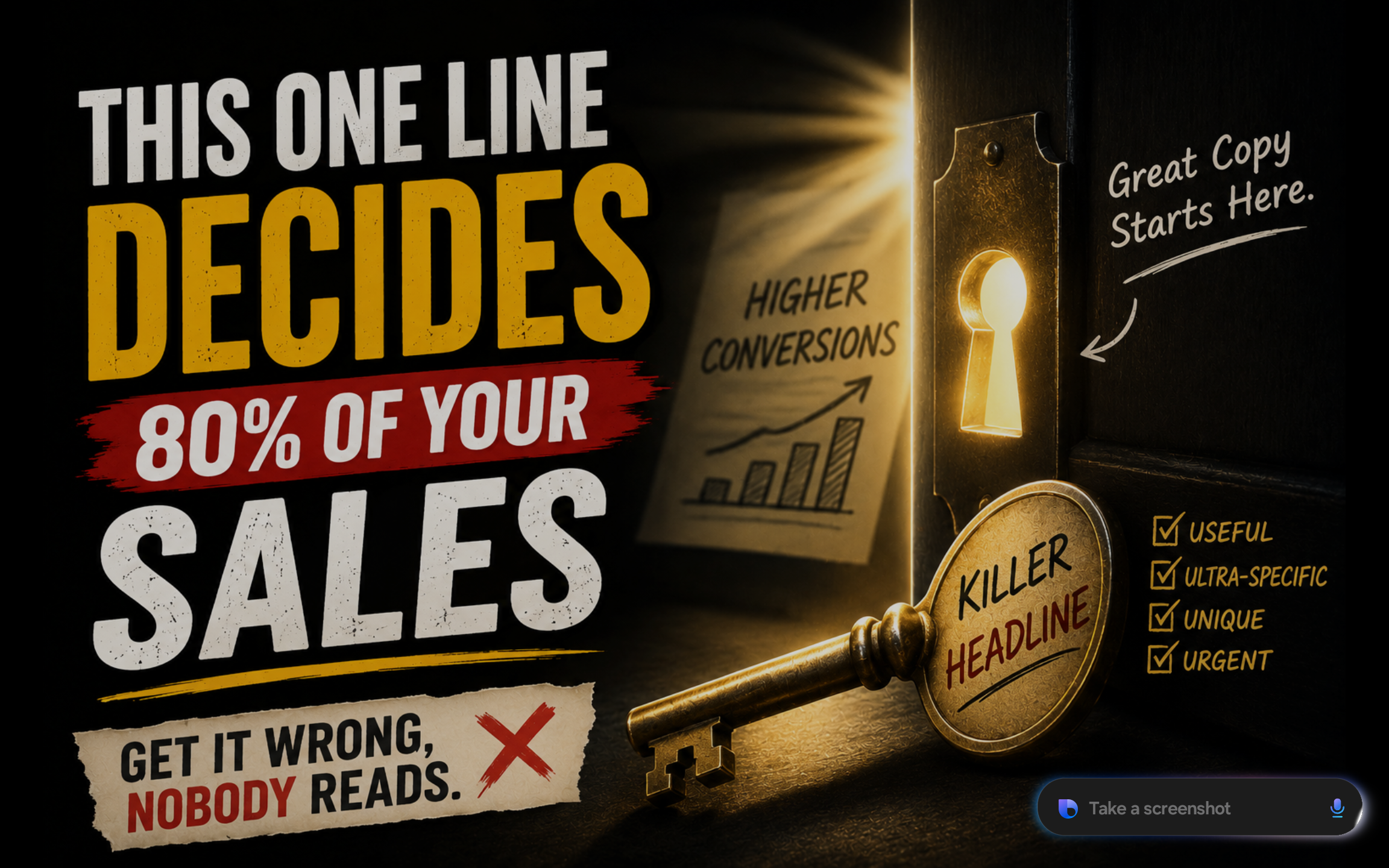
The headline is the door to your copy’s world.
Think about it for a minute. Why would a visitor even consider reading your “highly polished” sales copy if all they see is a trashy headline written in some fancy font style?
That’s right, they won’t.
This is one of the major reasons many beginners fail before their careers even take off. They consider the title an afterthought, something to quickly munch over when the rest of the article is finished.
Always remember, the objective of a headline is not to close the sale; it’s to grab the reader’s attention for the next few seconds so that your well-written copy can get a chance to do its magic.
The “4 U’s” Quality Filter
Famous copywriter Michael Masterson has given the classic 4U’s framework, which can help any beginner find their head in the game when it comes to writing headlines.
These are as follows:
- Useful: What will the reader gain by clicking on your title? It must contain some practical benefit for them, for instance, a direct solution to the problem they are facing.
- Ultra-specific: Go all-out on the specifics. Pinpoint it. No one likes a vague title. “Save 45 minutes on daily meal prep” is always going to outperform a title like “Save time cooking.”
- Unique: Make sure your headline has its own identity. If it sounds like the other twenty articles on the internet, the reader’s subconscious will classify it as slop, shattering the trust before it’s even built.
- Urgent: Do you want your visitor to click on your copy after 2 business days? Well, if you’re a sane person, then I don’t think so. Hence, pay attention to creating a sort of urgency in the headline, something that acts as a ticking clock, forcing them to click right that instant.
If all of this overwhelms you, don’t worry. You don’t need to use all of the 4 U’s in every title. Just make sure to include at least 2 of them, and you’re good to go!
Battle-Tested Headline Formulas
There are a few pre-made templates going around the industry that have helped a number of writers establish their footing. You don’t need to adhere to them, but it’s always good to have the knowledge.
The “How-To Without the Pain” Formula
| Template | Example | Why it works |
| How to <Achieve Desired Result> without <Roadblock> | How to pack for a 5-day vacation without paying for extra baggage. | Paints a clear and desirable outcome with the removal of the biggest hurdle. |
The “Costly Mistake/Warning” Formula
| Template | Example | Why it works |
| Are you making these <Number> mistakes with your <activity>? | 3 morning coffee habits that leave you exhausted by 2 PM. | The classic concept of loss aversion. Embarrassment or loss of money is the biggest catalyst. If people think something they are going to avoid a major mistake, they will act quickly. |
The “Curiosity Gap” Formula
| Template | Example | Why it works |
| The Simple <Routine/Tool> that <Unexpected Result> | The 10-minute life hack that keeps defrosted food fresh all day. | Presenting an unexpectedly simple solution to a known problem creates an itch in the brain. How does the reader get rid of that itch? By clicking on your article. |
The “Social Proof/Specific Group” Formula
| Template | Example | Why it works |
| Why <Target Audience> are ditching <Old Way> for <New Solution>. | Why busy college students are swapping coffee for herbal tea. | Develops a sense of familiarity in the reader. Appeals to their identity while leveraging social proof to challenge an outdated habit. |
What We Learnt
- Your headline is the front door leading to the mansion that is your copy.
- If the door looks shady, no one would bother going in.
- Don’t consider the headline as an afterthought.
- Draft at least 5 to 10 variations before you settle on one.
- Filter your headlines with the 4 U’s.
- Use the proven templates.
Now that we’ve mastered writing perfect headlines, our next focus will be on learning “The Slippery Slope Technique”.
Wanna know what it is? Well, like all other good things, this too will have to wait a little. Until then, ciao!
Articles in this series:
- The Beginner’s Guide to Copywriting: Definitions, Differences, and Daily Applications
- The Rule of One: The Golden Principle Behind High-Converting Copy (Part 2)
- Features Tell, Benefits Sell: The 3-Tier Value Ladder in Copywriting (Part 3)
- Cheat Code to Structure Winning Copy: Mastering PAS and AIDA (Part 4)
- The 80/20 Rule of Copywriting: Why Your Headline Makes or Breaks the Sale (Part 5)
More by Ritu:


Leave a Reply