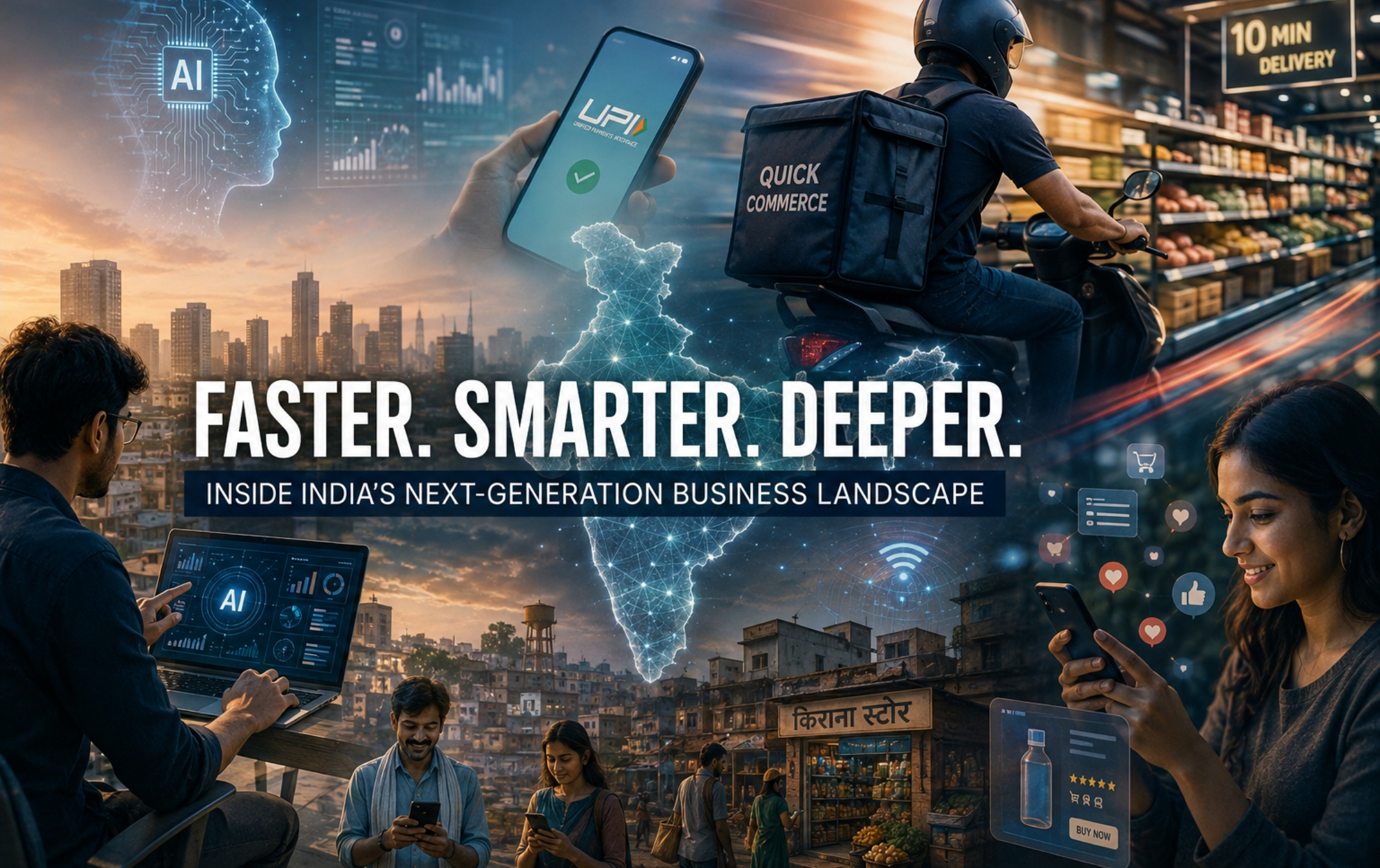
India’s commercial landscape is in the midst of a massive overhaul.
While legacy distribution models once dominated the scene, the focus has gradually shifted towards deep AI integration, hyper-convenience, and digital-first consumer habits.
Volume-led expansion, although still important, is slowly becoming a thing of the past.
Market dominance used to be decided by a business’s ability to establish physical presence.
As it has now taken the back seat, algorithmic efficiency, agile technology, and the capability to serve a vastly interconnected consumer base have all the spotlight.
AI and Digital Rails: From Infrastructure to Daily Operations
AI used to be the bleeding edge of technology. While it underwent extensive tech trials, that time period is long gone.
Now, AI tools have become household appliances, with people using them for tasks ranging from chatting to solving complex computational problems and programming.
Businesses are at the forefront of this race as well. Streamlining inventory forecasting and automating customer support are just a few examples.
Not only that, outsourcing real-time financial decision-making to AI has been embedded into the workflow now more than ever.
Fortunately for us, the country’s digital payment ecosystem has been keeping up.
NPCI’s Unified Payments Interface (UPI) has become the very core of this, handling over 24,000 crore transactions worth upwards of Rs.314 Lakh Crore annually.
Digital payments were a fringe concept until a few years after their launch. Now they are the default way to pay for almost every Indian.
The Evolution of Quick Commerce: Beyond 10 Minutes
The network of quick commerce dark stores has skyrocketed in recent years.
The focus has shifted from making 10-minute deliveries at any cost to actually building sustainable and profit-making entities.
Platforms are now focusing on better unit economics and higher contribution margins.
A major focus has been on increasing the Average Order Value (AOV).
This has been achieved by gradually shifting from focusing on perishable daily-use items to also including high-margin categories like consumer electronics, beauty & wellness products, apparel, and private-label goods.
The graph is only anticipated to grow further.
The Omnichannel and Social Discovery Flywheel
Consumers have also become much more aware over time. They no longer rely on physical storefronts and search-bar queries to hunt for their favourite products.
In fact, the whole industry has undergone a major overhaul in this aspect.
Short-form video feeds have revolutionised the way we shop. People trust their favourite content creators more than the local store vendor when it comes to making an informed purchase.
Consumers use the visual platforms at their disposal to discover new items, check their real-world reviews digitally, and make the purchase using the most convenient method available to them; be it an instant-delivery app, the official brand website, or even a local outlet.
The Non-Metro Momentum & Strategic Takeaways
All of this development is not just limited to the tier-1 metros.
With digital connectivity expanding rapidly, affordable smartphones and the availability of regional languages in them have unlocked a brand new segment of consumers in tier-2 and tier-3 cities as well.
India’s growth story has been phenomenal. Although there have been drawbacks, one can’t deny the leaps of progress achieved in such a short time frame.
New possibilities are sure to come our way if we keep leveraging AI-driven systems intelligently to make them work in our favour.
More by Riya:


Leave a Reply